

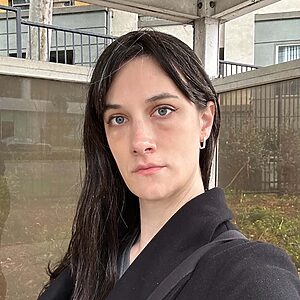
Skul Gurl is a pioneering electronic music producer, vocalist, and sound designer who has gained much attention online through her viral tutorial series on music synthesis and creative practice in the DAW. Today, in collaboration with DataMind Audio, she releases Neural Net Worth, a Free Sample Library of sounds from Combobulator (read , and shares her thoughts on AI & Music.
It feels like a naive and gauche thing to admit at this point, but there was a time as an artist where I was genuinely excited at the possibilities that AI-based tools could offer creatives. I played around with some of the earliest publicly available image and sound generators in the late 2010s, back when their output took ages to complete and was of incredibly low quality. That was what made them interesting to me, though. They were bad in ways a human would struggle to be bad in, as the AI tools would hallucinate things left and right. Figures in an image would bleed into the background and into one another in unnerving ways. A song would start out as an uncanny imitation of a piano ballad before morphing into a distorted mess of throbbing electronic noise. It was exciting, strange, and most of all, new. As someone that loves to push my creative work into uncharted territory, I was genuinely hopeful at the possibility of a future where these tools could be used to inspire and enhance my art.
As we all know, that isn’t the future we got. Rather than tools made with artists in mind, the overwhelming, centralizing version of generative AI today is one based around the theft and mediocre regurgitation of the creative spirit. Rather than offering something experimental, AI largely serves to give us inferior, uninspired versions of things we already have. It is the ultimate, terrible conclusion of a media landscape that was already hellbent towards endless recycling, rebooting, and predatory nostalgia. All while literally boiling the planet and draining all the drinking water.
Hooray!
This ugly modern reality has led me to feel stupid for ever believing AI could have been anything other than what it has become. As such, I have struggled to articulate the sadness I feel around not only the horrible damage to society and the planet that AI has wrought, but the death of the future I was excited for when seeing those strange and primitive generative AIs in action years ago. I don’t like the conclusion that there was never a better way AI could have developed. I think that idea cedes too much ground to the techbros of the world. One of the main ways AI companies sell themselves is by making AI seem inevitable and unavoidable. That your choice is not “use AI or don’t”, but “keep up or get abandoned by progress and cast into the streets”. Critically, though, they don’t just want to make AI seem inevitable, but their specific version of it. One where they can steal anything you make without a thought to consent or compensation. One where they own everything and you have to “pay them on a meter” for the right to access it. One where they get to claim any piece of the earth as fuel to feed their insatiable lust for data. They want to make sure you cannot imagine any other world than this.
I would like to imagine something better. Perhaps we cannot uninvent AI, but we are not powerless to watch it morph into something so detrimental to us. We can demand appropriate regulations around its use, and also demand better, more ethically developed versions of it that serve to aid rather than ablate the artist.
For as broadly anti-AI as I have become over the last few years, I still think this is possible. Part of why I think this is because I have seen such tools in action, specifically DataMind Audio’s Combobulator, an AI-powered tonal transfer plugin. When I was initially approached about the prospect trying the plugin out, I was immediately concerned about the prospect of it being a Suno-eqsue prompt-based slop machine, but Ben was kind enough to address all of my concerns. Contrary to my fears, I learned Combobulator is trained on datasets obtained with consent from the contributing artists, who were also fairly compensated for any sales of models trained on their data. Said models were trained on clean-energy servers, allaying my other big gripe about how AI tools are usually developed with no regard for collateral damage.
All of that was very encouraging to hear, but it would of course be meaningless if the tool itself was uninspiring to use. Thankfully, I can happily report that using Combobulator is some of the most fun I have had as a sound designer in a hot minute. As a tonal transfer plugin, it doesn’t generate audio de novo from a text prompt. Instead, it applies the timbral characteristics of the audio in its training data to the audio you input to it. This means you have to actively think about how the input you pass into Combobulator will interact with the specific model you’ve selected.

Combobulator
Some models are great at retaining harmonic integrity others will turn your chords into wailing drones. It strikes a great balance between producing unexpected results that inspire you with being predictable enough to use intentionally. Importantly (and I promise this is a compliment) its output is often BAD. But just like those early generators I fell in love with, it’s bad in extremely interesting and fascinating ways that are ultimately delightful. For example, I was generating some snare sounds, and when I ran them through a Comobulator model based on vocal data, expecting I might get something akin to beatboxing. Instead, they turned into percussive alien shrieks! While I could make a somewhat similar sound through layering snares and processed vocal chops, the seamless, hallucinatory blending Combobulator produced was wholly unique and dreamlike. It’s added a whole new angle of sound design to explore, and I get inspired every time I open it up.
Many AI tools sell themselves as a “collaborator” when they are really just a cheap shortcut, only appealing to those that think the creative process is something to be optimized into oblivion. You aren’t collaborating, you are sitting back and letting the machine do all the work. Even if something ostensibly “good” comes out, it’s a Pyrrhic victory at best. The result will be a hollow thing; none of you will be present within it. In contrast, using Combobulator is often a struggle and negotiation, it is rare that I land on something perfectly usable on a first attempt. I cannot stress enough that that is a good thing. Creating art should be a struggle. It is in that struggle that the idea is refined, and the artist is forced to determine if it is an idea worth fighting to bring into the world. I think the folks at DataMind get that, as their tools consistently require effort and intention from the user, but also reward that work tenfold. I am really eager to see what they make next, both in the realm of neural networks and otherwise. If there is to be any future for AI use in the creative sphere, it will be in the mold of tools like Comoboulator; ones that are made with humans in mind rather than endlessly escalating profit margins.
While I encourage you to try out Combobulator for yourself, I have also made a small set of free samples for you to get a taste of what it can make. This includes a handful of drum/bass one shots, some percussive and melodic loops, and some really cool drones and textures. I’m really pleased with this collection, I think it does a great job of showcasing the kinds of unique sound design that Combobulator is capable of. If you happen to use any of these sounds, please let me know, I would love to hear what folks make out of them!
Free sample pack — DataMind Audio members only
Sign in to your DataMind Audio account to grab the download — it’s free to join.
