

“Slop” is my favorite pejorative for AI generated media, evoking the image of some kind of cheaply made slush, churned out as endless rivers of meaningless artificial remediated garbage.
Neural Audio usually starts as slop: sounds generated by neural networks are often low fidelity, discordant, and lacking coherence across timescales. While these qualities make AI generated sounds difficult to incorporate in traditional roles, it can also be what makes them interesting and fertile for the discovery of new tricks in music production and sound design.
In my own music production sessions, Combobulator features heavily when I need something both digital and uncanny to groove along with the track… the “slop” sounds like an aesthetic choice when writing hard glitch / IDM / techno. I’ve also worked with a lot of strange sounds coming out of Dance Diffusion and Stable Audio, where I can make models trained on corpus of my own sound design and discography, as featured heavily on my album Data Séance (Ophelia Records, 2025). While it was remarkable how uncanny these models could get, I’ve still been faced with the task of either cleaning up artifacts or fully embracing the weirdness of sounds made by custom neural networks.

Data Séance by Zebbler Encanti Experience
Regardless of ingredients used or aesthetic decisions made, I tend to hold myself to a simple yet high expectation as a music producer regarding my output: “it has to be good” …but what is good? Given the frictionless nature of generating AI sounds, and especially when considering the big-picture dangers AI technology poses towards the environment, commerce, and craft, the bar must be higher than “good” – the music made with neural audio needs to be extraordinarily good to justify its existence.
This is the essence of the creative spirit that dominated the new works created for the AI Performance Playground at this year’s Sonar Barcelona, which I recently co-facilitated with Anna Xambó. Over the course of four movements, the artist residents created works with AI and MIR technologies that not only sounded good, but also had well-developed artist statements, and a deeply interrogated sense of interconnectivity between all the moving parts. The pieces were absolutely stunning, in how they showcased innovation, meaning, vision, and raw talent. This was AI generated media becoming more than its outputs and transcending all trace of slop.

AI Performance Playground at Sonar Barcelona 2026
I find it endlessly fascinating how AI can be gross in one context, and extremely beautiful in another, which has led me to seek a heuristic framework for what exceptional work looks like while working with this kind of material. What principles might help ensure that I produce my best work, if the ingredients hold no inherent value, motive, or contextual awareness? If I’m working with slop, how do I create something that is not slop?
The Humm Principles

Eleven Madison Park
During the Covid-19 pandemic, Award-Winning Chef Daniel Humm closed Eleven Madison Park, the only fine-dining restaurant in the world to hold both 4 stars from The New York Times and 3 stars from the Michelin Guide. When the restaurant re-opened, it was announced that they would only serve plant-based menu items moving forward. Much of the kitchen staff quit immediately on this news, because in the goosefat and butter-laden world of high end cooking, Eleven Madison Park’s announcement would put them in the precarious position of being the only 3-star Michelin restaurant in the world to ever exclude meat and dairy.
To guide the transition of Eleven Madison Park’s menu into plant-based ingredients, Humm identified four fundamental principles that enables him to move between any ingredient base, no matter how unprecedented and outrageous, without sacrificing the integrity of his work:
- It has to be delicious.
- It has to be beautiful.
- It has to be creative.
- It has to be intentional.
Something clicked when I first heard this. It’s such an elegant, principled theory for making exceptional work, regardless of ingredient or precedent, already tested and put to practice by someone who is among the best in the world at what they make.
Humm’s principles point towards stages of information-processing behind how we experience art, called neuroaesthetic layers of perception. Neuroaesthetics describe an inward journey of how perception processes a work as emotionally provocative and valuable, describing aesthetic experiences as “emergent states, arising from interactions between sensory-motor, emotion-valuation, and meaning-knowledge neural systems” (Neuroaesthetics 2014). Through the lens of neuroaesthetics, the way that food is experienced across different regions of the mind is directly translatable to the aesthetic experience of art or music.
Delicious
“The art of life lies in taking pleasures as they pass, and the keenest pleasures are not intellectual, nor are they always moral.” ~ Aristippus (c. 435–356 BC)
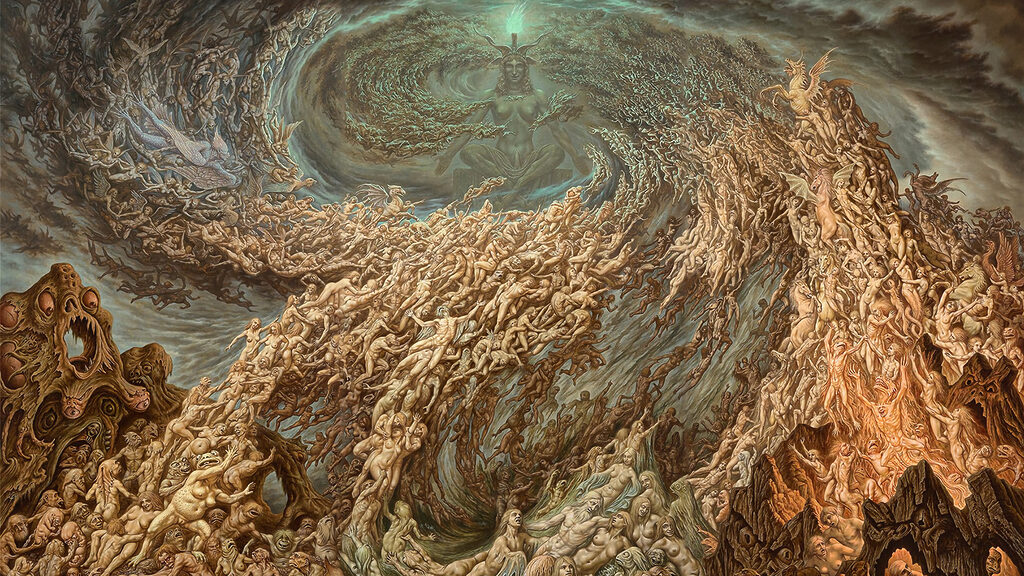
Deliciousness is an immediate, intrinsic, thought-free sensation that arises from the nucleus accumbens, the center of our brain’s reward system, which is the very same “hedonic hot spot” that we get from a delicious meal. It is the binary experience of “yes, I like this” without any thought around it. A part of musical enjoyment therefore occupies the same part of the brain as what we consider delicious, as they both inhibit dopamine and are enjoyable in an immediate and involuntary sense.
The Adoration of Pan by Johfra Bosschart
Deliciousness as thoughtless entertainment – feeling over depth – is the domain that the current wave of commercial AI text-to-music generators are designed to thrive in. With Suno, Udio, and other long-form music generators, we have a technology that can produce complete works at the press of a button, without anything else needed to instantly arrive at the hedonic pleasure of listening to it. The idea here is that, if deliciousness is indulgence embodied through the sensation of music, perhaps it can be enjoyed regardless of where it came from or how it was made, regardless of anything except the immediate amusement it provides. This is essential to the business thesis of a company like Suno, as implied by CEO Mikey Shulman, who has repeatedly referred to his AI music platform as conduit for “meaningful entertainment experiences”, and while identifying “Impatience” in music as a virtue on their website: Suno wants everybody to buy the idea that the skills and craft, which gives shape to meaning and depth, are mere obstacles to getting music made, and what the consumer really wants is the expediency of reaching an amusing end product. Despite how ridiculous this might sound to many music practitioners (Personally, I’ve never registered anyone’s impatience as particularly virtuous), this business thrives because it caters directly to hedonic pleasure centers.
AI music generators represent a similar threat to music as fast food is a threat to culinary arts: when an average hungry person is looking for a dopamine hit, “good enough” with artificial ingredients might be just as suitable as grass-fed ingredients from a reputable chef (especially when it’s cheaper). As Doug Shapiro warned at AI On the Lot 2025: AI generated media presents the trade off of “80% of the quality at 10% of the cost”.

Gen AI Disruption in Media Industry – Doug Shapiro Keynote at AI On the Lot 2025
Working with neural audio in the kitchen of electronic music production (not as a full song generator but as a sound design and compositional additive) decisions have to be made as to whether the ingredients are suitable for making exceptional artwork. 80% quality of a regular sample or musical idea, across any time scale, might be delightful to listen for some, but also presently has inherit limitations as a premium value-add. To transcend the latent artifacts and become something exceptional, there often needs to be more to the sound than the generation stage, just like oscillators need to be paired with filters, envelopes, and LFOs to sound like an instrument. The most delicious parts of neural audio typically need to be refined, processed, and developed to bridge this gap: filtering, compressing, denoising, and morphing for sound design; quantization, re-scoring, and re-arranging for composition.
And then there is another kind of deliciousness that awaits those who find time for patience: the less probable sounds summoned from neural networks, the “glitches” on the outer edges of latent spaces, can sometimes be coaxed into producing viable candidates for sound design that are incredibly delicious in the right context. Like a distorted guitar or detuned synth, neural networks can communicate through their own aesthetic, and may provide a different kind of delight when efforts to directly imitate the training data are largely abandoned (there is some great research exploring this area, called “active divergence”). I see no reason why the squeal of a breaking neural network or the hum of a latent noise floor cannot communicate immediate emotion under the right compositional conditions.
To be sensational, without need for thought or contemplation, is a good thing. Hedonic pleasures in music are foundational to music’s role in history and culture. But it’s not the only thing.
Beautiful

“Look at (this image). What are you feeling about it? Is it beautiful? Is it exciting? I’m watching your faces very carefully… Now I’m going to tell you what it is. Are you ready? This is the last act on this Earth of a little girl called Heidi, five years old, before she died of cancer to the spine. It’s the last thing she did, the last physical act. Look at that picture. Look at the innocence. Look at the beauty in it. Is it beautiful now? ”
–Richard Seymour: How Beauty Feels, TEDTalks 2011
Is there such a thing as intrinsic beauty, or is beauty in the eye of the beholder? This is a careful question that high-profile corporate designers must navigate while honing in on design decisions that could make or break a brand. In the visual world, capturing the eye is one thing, but designer Richard Seymour suggests that beauty is felt. Intrinsic beauty might exist, but it is “very hard to find something that, to everybody, is a very beautiful thing, without a certain amount of information packed in there before. So a lot of it tends to be extrinsic.”
Whereas deliciousness exists in the immediate perception, beauty extends further into the orbito-frontal cortex, to be augmented by the impact of cognition. When a stimulus carries a deeper meaning to the beholder, the feeling of beauty gets stronger: Context helps make art feel beautiful.
In the musical sense, context is not the same as thought – context is the extrinsic stimuli that invites an awareness that is experienced emotionally. Within the first milliseconds of perception of any musical composition, a context window opens and expectations begin to appear in the mind of the listener. Beauty in music can often be found simply in the delicate balance between how created expectations are observed or subverted.
Elements of expectation and context permeate all forms of musical composition, conditioned into our psyche throughout human history: the feeling of knowing when a tonic resolution is supposed to follow a cadence, or when a chorus flows out of a verse, or when a snare follows a kick – Music is built upon centuries of context that composers must choose how to reconcile with. It is no mistake that the musical term “genre” derives from the same Latin root as gene and generation: Music typically evolves from embellishments of formally established musical ideas, with the strongest ideas usually sticking around, in an ongoing generational exchange of the collective unconscious.
In modern times, a recording’s imagery, artifact, and lore invite deeper meaning: album art, liner notes, studio tales, concert experiences, web presence, an artist’s persona, or the mystique, all contribute to the perception of beauty in a piece of music. The cultural context, the time and place and circumstances that music is born out of, invites emotional resonance and introspect. As a neuroaesthetic, art that is perceived to be authentic tends to be perceived as more beautiful than inauthentic art. Ask any record collector what makes their favorite album beautiful and listen to the stories they tell to get a sense for how information about the piece factors into its value.

Sophie
This is a missing ingredient for mass-market text-to-music music generators: if music arrives at the push of a button, fully formed without origin, without a story or an artist behind it, where does one derive a deeper sense of substance beyond hedonistic pleasure? Anti-AI activists are not angry about AI because of its fidelity, nor are they particularly against machine learning technology itself – they’re mostly angry because the music is inseparable from its shady origins, coming from tech companies training models on stolen material. Opposition to the process itself is what makes AI music the opposite of beautiful in the eyes of many. This has become the backdrop for nearly all AI generated music controversy: a legacy of cultural theft and corporate productization occupies the place of a good story, an artist, or a craft that might have made the music that much more beautiful. Artists using AI transparently have the unique challenge and responsibility to develop a compelling message through their work that’s louder than the message inherent to the medium.
Humm says that beauty “feels effortless, almost something that just happened, that just fell from the sky and is beautiful.” Beauty cannot be forced, as histories cannot be rewritten. It is as natural as the rain: The processes that make flowers blossom and rainbows shimmer have an aesthetic quality that is inseparable from the beauty that these processes create. Beauty makes sense. When you zoom all the way out and see a piece of music in the wider frame, with all the extrinsic factors that caused it to exist surrounding it, situated besides everything else that lends context to what it is, and the piece gets even better… that’s beauty.
Music producers using neural networks in their work have the responsibility to make their music just as beautiful on an extrinsic level as it is enjoyable on an intrinsic level. The story, the artist statement, the craft and processes involved above and beyond the AI, with evidence of humanity and patience apparent in the work, all factor heavily into how truly beautiful music is going to be perceived.
Creative
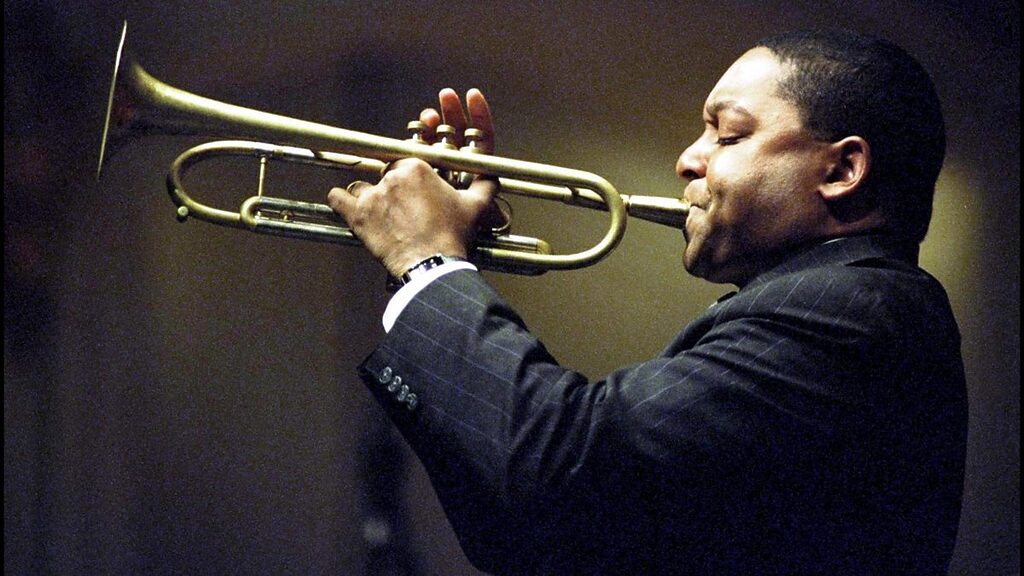
“Some time ago, the tenor saxophonist Frank Foster was playing a street concert from the Jazzmobile in Harlem. He called for a blues in B-flat. A young tenor player began to play “out” from the first chorus, playing sounds that had no relationship to the harmonic progression or rhythmic setting. Foster stopped him.
‘What are you doing?’
‘Just playing what I feel.’
‘Well, feel something in B-flat motherfucker.’”
~ Wynton Marsalis, “Moving To Higher Ground” (2008)
While Beauty and Deliciousness are qualities perceived by the listener, Creativity points away from the artifact, and towards the process behind how something was made. Creativity as a quality is not therein contained in the piece itself, but a culmination of the implied qualities and skills behind making it – an inferred assessment of the context and process through which the artwork is conceived.
When a piece of music sounds creative, we engage with a sense of wonder that, somewhere behind the sound, there was a well-executed process and decisions that were well-made. This part of the mind is called the meaning-knowledge system in neuroaesthetics: a part of “the aesthetic triad” that exists beside sensory-motor and emotion-based processing. Perception of creativity comes from inferring a certain depth in the process that produced the piece. People are usually called creative for their ability to see beyond the obvious application of tools, and to push their mediums to new places that open new opportunities for expression – like Lee Scratch Perry bringing delay line feedback into the mixing desk to invent “dub”, Jimi Hendrix pushing his amp to max gain to create distortion, and Miles Davis utilizing the amplification of microphones to play impossibly long notes with quiet breaths.

Sun Ra
Creativity must have a distinctive impact beyond exhibiting novelty, requiring “both originality and effectiveness” for something to be creative. It took years of practice for me to learn that originality alone is not inherently creative. Any random sequence of numbers or letters, for example, is technically original, but whether it is effective within a context is what makes it creative. How does it fit, and what utility does it offer, and what are the implications in context and practice? Creativity must rise to an occasion. It is generally accepted in my Berklee College of Music circles that you can’t just play random notes and call it a jazz solo (unless, of course, you’re Sun Ra).
If we aspired to be creative and not just create with AI music, perhaps we can narrow the role that generative AI might play in electronic music production. Whether we treat neural networks as a conduit for transformation, a vessel for exploration, or a module for combination with other modules, the enigmatic terrains that latent space opens up represent a rich field of possibilities to be both original and effective in music, embodied through acts of creativity.
Intentional

“Christo once showed me a photo of an old motorcycle he wrapped in rope and plastic sheets, and sold for several thousand dollars. ‘But I could have done that,’ I said, ‘Ahhh,’ he smiled, ‘but you didn’t!’”
~ 1975 June 22, The Press Democrat, Christo’s Fence: What Does It All Mean by Pete Golis, Quote Page 3A, Column 1
We finally arrive at the anterior cingulate cortex, where executive functions combine with actionable motivations to do creative work. This is the last layer of perception to be reached by the listener, but for the maker, often the first to be realized.
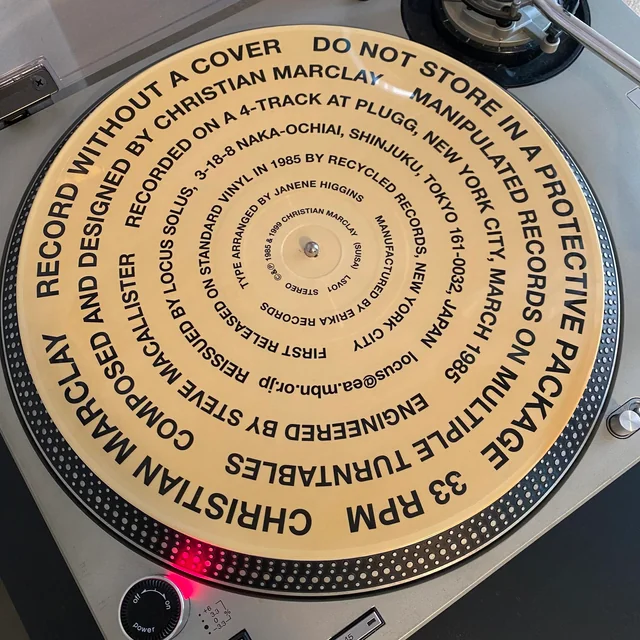
Intent concerns the reasoning around the creative actions that lead to the production of a beautiful and delicious output. At this point we are no longer talking about the work directly, or even the process of creating it, but the thinking around the need to be creative. Intention is the work’s purpose for being – the reasoning that evoked the creative act. Sometimes intention plays an active role in the work, integral to the artistic statement, and other times intention may be implied subtly, mysteriously, or be invisible altogether from the perceiver’s experience of the work.
“Record Without A Cover” by Christian Marclay
Intention is the human faculty of authorship that a machine learning algorithm cannot materialize. Neural networks have no awareness, context, or motivations; its outputs, no inherent value… But if an artist were to generate a neural audio soundscape, and do something creative with it, suddenly the artistic intent becomes central to the value and positioning of the work. The piece itself is a material expression of the creative vision that is born of an author’s intention.
I heard a challenging piece recently – Vox Humana by Roman Grygoriv, played at a lecture by Iryna Tukova. The composition features contorted overtones and shrieking harmonics accompanied by the antagonizing crescendo of an equally discordant chamber orchestra. Out of context, this piece may have been simple to write off as an avante garde experiment … but then I realize that the “lead instrument” of this ensemble is the shell of a MLRS BM-27 Uragan missile, bowed by a Ukrainian composer that’s experienced personal devastation by the war. The screeching harmonics and overtones are created by bowing the very same missile Russia was actively launching at Ukraine. Tukova writes how Vox Humana was created as a performative mode of resistance, and an expression of death itself. Experiencing Grygoriv’s Vox Humana, the artist’s intention in the context of the piece felt like an enormously important part of experiencing it. While Beauty is experienced through this contextual awareness, which is Creative in its execution, Intention involves the depth of reasoning around the actions that conceived of such a Delicious output.

Vox Humana by Roman Grygoriv
This is an essential element to meditate on when working with neural audio, which links in with all the other Humm fundamentals: Why must this exist? I bring this question into my practice often when deciding upon what kind of tool to use: If I can accomplish a creative idea more effectively without using generative AI, then the reason to use it loses potency. Intention forces the artist to think beyond the novelty of working with interesting technology outright, towards a vision that serves the piece. Intention is the vision, embodied by a creative process: “I had a reason to do this, and in this way specifically”.
In the creation of his video essay “Suno, AI Music, and the Bad Future”, Adam Neely held a poll where he asked Suno creators: What have generative AI tools like Suno empowered you to do that you cannot do with DAW’s or traditional musical instruments? “All the answers were about saving time, saving money, and replacing friends,” reported Neely, “In other words, Suno lets you make the same music faster, cheaper, and lonelier. I’m not sure if that’s a good thing.” I tend to agree with Neely’s assessment: If generative AI use is primarily motivated only by utilitarian roles, some which arguably exist to diminish the artform, the intention loses defensibility.
Intention does not need to be a grand gesture. My music has often begun with vague goals like combining genres (“psy trap” was my magnum opus), or trying to make a certain combination of chords work well, or exploring a rhythmic motif to its fullest extent. Intention is the invitation to be creative: When working with technologies that offer seemingly limitless timbral space, intention is the vision that creativity coheres around.
When Do We Eat?
When taken all together, the Humm principles could be effectively used to critically audit the neuroaesthetic impact of just about any musical project, across any genre with any kind of strange sounds or materials. When each principle is satisfied, the piece becomes fit for human consumption.

A Dish by Daniel Humm
AI generated slop is an empty vessel that can only ever be delicious in its raw form, at best. The job of the artist is to cook it up, and situate the sounds and musical structures so they appear to be beautiful, in a way that is creative and intentional. When we bring process, craft, and context into the piece, neural audio stops being slop and turns into a vessel for artistic expression.
As a heuristic framework, it is applied and experienced subjectively: deliciousness and beauty is a matter of taste and perspective; musical goals can have moving targets; and a sound that gives me chills may not have the same effect on someone else. Use your best judgement here. These principles are meant to navigate unprecedented terrain, and to provoke an interrogation of one’s practice in a manner that encourages the creation of exceptional work. When these neuroaesthetic areas cohere, the meal tends to become worthy of appearing on the menu, no matter how unprecedented the ingredients may be.
Now go forth, and make a meal out of slop.


